

JAPANESE WOMEN LEARNING REAL FAST
by Tatsuo Shimoda
Ring Wrestling, April, 1965|
TOKYO, JAPAN -- Two hefty Amazons, dressed in regulation coarse cotton blouses, shorts and a length of thick, broad girdle which is wound several times around their ample waists and between their limbs, and knotted in the rear, slam into each other like charging hippos in a hard, dirt ring. The loser will either be pushed, lilted or hurled out of the circle in a matter of seconds. Or, she can be tripped or thrown to the ground. In any case, a sumo bout is short and rarely goes beyond a few minutes. The initial impact would knock the breath out of an ordinary female but the protagonists are no examples of genteel Japanese womanhood. They are women wrestlers against whom the average male wouldn't stand a chance in a test of strength and stamina. The rules and ritual for women wrestling is almost identical with those in the style controlled by the Japan Sumo Association. The fancy trappings are missing. The only difference is that the female grunt and groan experts are part-time pros. They engage in the tough sport only at shrine festivals in towns and villages. The women engaged in the rough sport, unlike American female wrestlers, lack glamour. They are well-built, powerful women who take their avocation with the earnestness of a pro sumo. They are not fashion models.
At a tournament, the females many of whom are middle-aged mothers, are divided into East and West teams. The stronger ones are matched toward the end of the program. Their cotton blouses and tight knee-length shorts conceal rather than enhance their physical assets. The girdles are indispensable pieces of apparel as the contestants usually grip each other by the "mawashi" girdles) and lift or throw their opponents. However, women-s sumo never has been taken seriously other than as entertainment at rural festivals. Its growth was doomed as very few girls were cut out for the rugged sport. As a result, women sumo wrestling is near death. There are still remote communities where the ancient sport is staged with local women pitting their skill and strength against each other at shrine carnivals. It was a few years after the end of World War I that American professional and variety baseball teams first visited Japan. Among the various American type sports introduced here was a show featuring pretty American gal wrestlers. In 1919 a Yankee troupe of statuesque women wrestlers came here to perform in public. Naturally, there was not a single local girl to test her strength and skill against these Amazons
The Japanese of those days were unfamiliar with Western style wrestling in any form, and consequently promoters could not be found to stage contests. Records show that these American wrestlers performed at geisha parties before private gatherings of well-heeled, expense account Businessmen, executives and politicians. The spectators applauded the rough and tumble going-on while sipping sake served by geisha in the gay, exclusive Akasaka quarters. I believe these are the first recorded cases of American women staging wrestling bouts before Japanese spectators. Because these shows were staged only before private groups, the public was unable to become familiar with the newly imported entertainment. Around 1921, an American matman named Ad Santel came here and hurled challenges at professional sumo wrestlers and judoists, but for some unexplained reasons, his challenges almost went unanswered. One man, Hikoo Shoji, of Kodokan, the mecca of judo, accepted Santel's challenge. Whether a match really took place, and if it did, the outcome, is unknown. But it is known that Shoji was threatened with expulsion from Kodokan. This was the first time that Japanese public showed interest in wrestling. This interest was short-lived as it ended with Santel's departure. Pro wrestling, as it is known today, came into its own after the late Rikidozan, known as Riki to his numerous fans, organized and promoted pro wrestling. The Korean-Japanese wrestler, who died in 1965 about a week after he was stabbed in the abdomen by a gangster in a night-club brawl, turned to the new sport. The present day brand of women pro wrestling was introduced in 1956 when a group of seven American blonde and brunette wrestlers arrived in this country to entertain American troops. Among them were Mildred Burke, Gloria Barattini, Beverly Anderson, Hita Martinez Ruth Boatcallie and Mae Young. Local promoters recognized the possibilities of staging an American-Japanese contest and promptly began recruiting girls to perform with the bigger and heavier American girls. Four were selected, including Miss Sadako Ikari, who tangled with the American girls during their tour of Japan. The biggest local girl was Miss Masako Hashimoto. She stood 5 feet 7 inches in her stockinged feet and tipped the beam at 147 pounds. Even this rare specimen of Japanese womanhood was dwarfed by the Americans. The foreign talent proved too powerful and experienced. The Japanese girls were instructed by judoists and others who laid claim to knowledge of pro wrestling. Soon, women-s wrestling clubs and promoters mushroomed in major cities all over Japan. In order to popularize this new form of entertainment, the Tokyo Pro Wrestling Association was organized.
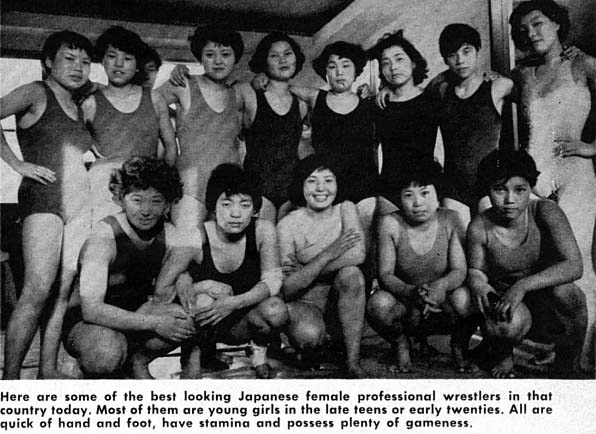
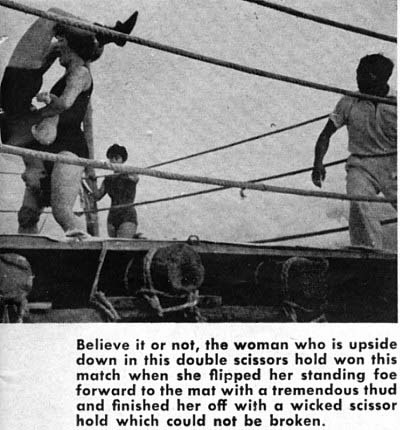
A commissioner was named and things looked rosy at first but the sport failed to catch the public's fancy. Two factors were primarily responsible for the failure of the venture. First, unlike American wrestlers, the Japanese counterparts were big but were of the homely, plain type. Second, the limited number of aspirants. The television stations' refusal to program women wrestling also spelled finis to the sport. Various women-s and mothers' organizations vigorously protested the telecasting of young women in form fitting costume "engaged in unladylike contest." Among the outstanding lady wrestlers were featherweight Miss Kiyo Obata, who was awarded the championship when favored Miss Shoko Katsura committed a foul in the seventeenth minute of a 20-minute title match. Tetsuya Kawai, of Yokohama, who promoted womens' wrestling, summed up the failure in these words: "It is a tough job to train women wrestlers. In order to teach girls of marriagable age the tricks of the game, judoists were engaged. The instructors first had to teach them the ABC of wrestling. To make matters worse, often the trainer and the trainee fell in love and most of them got married. "The girls who married their instructors improved rapidly. After two or three years of intensive training some of them could throw male judoists of the first grade black belt rank without difficulty. The majority of the girls were high school graduates, daughters of small shopkeepers. Some were former professional cyclists and a few were college graduates. Their sole interest in wresting was the purse. "The main eventers made anywhere from $84-$139 an evening. Girls getting top billing usually were able to perform two nights a month. "When the popularity of girl wrestling declined, the girls had to hit the road and perform in provincial cities and travel even to Okinawa and South Korea. Kawai concluded on a pessimistic note: "Unable to sign contracts with attractive guarantees, the girls formed troupes of four or five members and now are performing in cabarets and night clubs." |

Article and pictures provided by Hank Bratton of Women-s Wrestling Illustrated.
